
Decode Your Ford VIN for Free
Use our Ford VIN decoder to check basic vehicle details by VIN, including year, model, trim, engine, body style, drivetrain, fuel type, MSRP, and estimated market value. Start with a free VIN decode to confirm key Ford specs before you buy, sell, repair, insure, or research a vehicle.
What Is a Ford VIN?
A Ford VIN is a unique vehicle identification number assigned to a Ford car, truck, SUV, van, or commercial vehicle. Most modern Ford vehicles have a 17-character VIN made up of letters and numbers.
A Ford VIN number helps identify important vehicle details such as model year, manufacturer, vehicle type, body style, engine information, assembly plant, and production sequence.
What Can You Check With a Free Ford VIN Decoder?
A Ford VIN decoder free lookup helps you confirm basic vehicle details before you buy, sell, insure, repair, or research a Ford.
Depending on available data, the decoder may show:
- Year
- Make
- Model
- Trim
- Body type
- Vehicle type
- Engine description
- Engine size and specs
- Engine configuration
- Transmission style
- Drive type
- Fuel type
- Country of manufacture
- Assembly plant
- Number of doors
- Standard seating
- Exterior dimensions
- Interior dimensions
- Ground clearance
- Suspension
- Braking
- Steering
- Tire pressure and size
- Wheels
- Tank capacity
- Trailering details
- Front airbag information
- Seat belt type
- Emissions
- EPA class
- MSRP
- Estimated market value
Need More Than Basic VIN Specifications?
A basic VIN decode helps you confirm the vehicle’s identity, specifications, MSRP, and estimated market value. If you need deeper details before buying, selling, or documenting a Ford, you may need a vehicle history report.
A full Ford vehicle history report may include:
Salvage Brand
Identify salvage branding that may indicate prior major damage.
Accident Record
Review accident history to understand possible damage or claims.
Ownership History
See ownership changes to understand how the vehicle changed hands.
Auction Records
Check auction listings, sale dates, prices, and condition notes.
Odometer Readings
Review mileage entries to help identify possible inconsistencies.
Theft History
Check theft records to identify possible stolen vehicle activity.
Lien or Loan Records
Check finance records that may affect purchase or ownership.
Title Brand
Check title branding that may affect value, ownership, or resale.
How to Decode a Ford VIN
Decoding a Ford VIN is simple. Follow these three steps:
- 1
Decode VIN
Enter the full 17-character VIN into the decoder. Make sure there are no spaces, missing characters, or typing mistakes. - 2
View Specs
Review the decoded specifications, such as model year, model, trim, engine, body style, drivetrain, fuel type, MSRP, and estimated market value when available. - 3
Choose the Right Next Step
If you need more than basic specs, choose the right report for your goal. Get a vehicle history report if you need title, accident, odometer, theft, lien, auction, or ownership-related records.
How to Read a Ford VIN Number
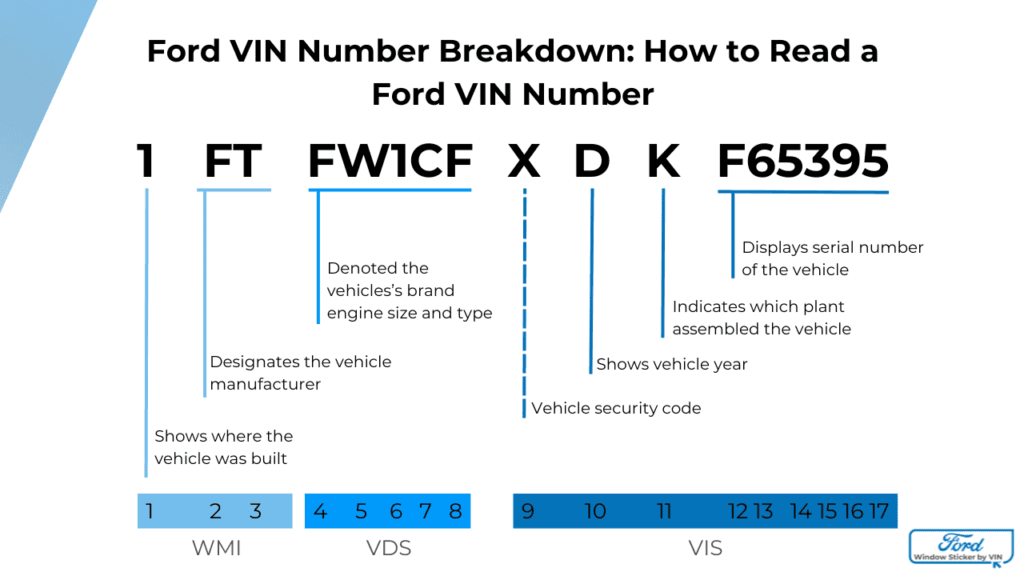
A modern Ford VIN is made up of 17 characters, combining letters and numbers. To prevent confusion, the letters I, O, and Q are not used in modern VINs because they can look like the numbers 1 and 0.
For easier interpretation, the VIN is divided into three main sections. Each section reveals a different layer of information about the vehicle.
World Manufacturer Identifier, or WMI:
The WMI is placed in characters 1 through 3. It identifies the manufacturer, production region, and general vehicle type.
Vehicle Descriptor Section, or VDS:
Characters 4 through 8 describe the vehicle itself. This section may include details such as body style, engine type, restraint system, model line, or vehicle series.
Vehicle Identifier Section, or VIS:
Characters 9 through 17 identify the check digit, model year, assembly plant, and production sequence. This section helps separate one Ford from another.
Ford VIN Number Breakdown Example
Here is a simplified example using this VIN:
1FTFX1CT9CFD06231
| VIN Position | Example Character | What It Helps Identify |
| 1st | 1 | Country or region of manufacture |
| 2nd | F | Manufacturer |
| 3rd | T | Vehicle type or division |
| 4th–8th | FX1CT | Body, series, restraint, engine, or vehicle attributes |
| 9th | 9 | Check digit |
| 10th | C | Model year |
| 11th | F | Assembly plant |
| 12th–17th | D06231 | Production sequence number |
This type of breakdown helps you understand how Ford organizes vehicle identity data. The exact meaning of some characters can vary by model year, model line, body style, and market, so using a decoder is faster than reading the VIN manually.
Characters 1–3: World Manufacturer Identifier
The first three characters are called the World Manufacturer Identifier, or WMI. This section helps identify the manufacturer, production region, and general vehicle type.
Common Ford WMI examples may include:
| WMI | Common Meaning |
| 1FA | Ford passenger vehicles produced in the United States |
| 1FM | Ford multipurpose vehicles produced in the United States |
| 1FT | Ford trucks produced in the United States |
| 1FD | Ford incomplete or commercial vehicles produced in the United States |
| 2FA | Ford passenger vehicles produced in Canada |
| 2FM | Ford multipurpose vehicles produced in Canada |
| 2FT | Ford trucks produced in Canada |
| 3FA | Ford passenger vehicles produced in Mexico |
| 3FM | Ford multipurpose vehicles produced in Mexico |
| 3FT | Ford trucks produced in Mexico |
| WF0 | Ford vehicles commonly associated with European production |
WMI codes can vary by market, production year, and vehicle type. For the most reliable result, run the full VIN through the decoder.
Characters 4–8: Vehicle Descriptor Section
Characters 4 through 8 describe the Ford vehicle. Depending on the model and year, this part of the VIN may include information about:
This is where a Ford VIN number lookup is useful. Instead of relying only on the seller’s listing, you can decode the VIN and compare the result with the actual vehicle.
Character 9: Check Digit
The ninth character is the check digit. It helps verify that the VIN follows the correct structure.
This character does not describe the model, trim, engine, drivetrain, or body style. It is mainly used to help detect invalid VINs, typing mistakes, or incorrect VIN patterns.
Character 10: Model Year
The tenth character identifies the model year. This helps confirm whether the vehicle year matches the listing, title, registration, insurance document, or marketplace description.
| Code | Year | Code | Year | Code | Year |
| A | 1980 / 2010 | L | 1990 / 2020 | Y | 2000 |
| B | 1981 / 2011 | M | 1991 / 2021 | 1 | 2001 |
| C | 1982 / 2012 | N | 1992 / 2022 | 2 | 2002 |
| D | 1983 / 2013 | P | 1993 / 2023 | 3 | 2003 |
| E | 1984 / 2014 | R | 1994 / 2024 | 4 | 2004 |
| F | 1985 / 2015 | S | 1995 / 2025 | 5 | 2005 |
| G | 1986 / 2016 | T | 1996 / 2026 | 6 | 2006 |
| H | 1987 / 2017 | V | 1997 / 2027 | 7 | 2007 |
| J | 1988 / 2018 | W | 1998 / 2028 | 8 | 2008 |
| K | 1989 / 2019 | X | 1999 / 2029 | 9 | 2009 |
Because VIN year codes repeat, the full VIN and vehicle context are important for confirming the exact model year.
Character 11: Assembly Plant
The eleventh character identifies the assembly plant. This character helps show where the vehicle was assembled.
For example, a Ford truck VIN may use a plant code tied to a specific production facility. The meaning can vary by model year and vehicle line, so it is best to decode the full VIN instead of relying on one character alone.
Characters 12–17: Vehicle Identifier
The final characters identify the specific vehicle within a production sequence. These characters help separate one Ford from another, even when two vehicles share the same year, model, trim, engine, and body style.
Together, the final VIN characters help identify the exact vehicle, not just the model line.
Popular Ford Models to Explore with our Ford VIN Decoder
You can easily decode any Ford VIN format - standard 17-digit or classic car VINs ( 5- 14 digits long) using our Ford VIN number decoder. Here are some Ford models you may be interested in:
| F-150 | Ranger | GT |
| Mustang | Edge | Taurus |
| Explorer | Super Duty | Flex |
| Bronco | Fusion | Fiesta |
| Maverick | Focus | Lightning |
| Expedition | EcoSport | C-Max |
| Escape | Transit |
← Scroll horizontally to see more →
Decode Your Ford VIN and Get Deeper Reports
Check basic Ford specs for free, including model year, trim, engine, drivetrain, MSRP, and estimated market value. Need deeper records? Get the paid Ford vehicle history report for title, accident, odometer, theft, auction, ownership.
Frequently Asked Questions
Yes. You can use the free decoder to check basic Ford vehicle details. If you need deeper information such as original MSRP, factory options, packages, title history, accident records, or ownership records, you may need a paid window sticker or vehicle history report.
To understand how to decode a Ford VIN number, read the VIN in sections. The first three characters identify the manufacturer and vehicle type, characters 4 through 8 describe vehicle attributes, the 9th character is the check digit, the 10th character shows the model year, the 11th character shows the plant, and the final characters identify the production sequence.
A Ford VIN can help identify the vehicle’s year, make, model, trim, body style, engine, plant, and production sequence. Additional reports may show factory options, MSRP, warranty details, title records, accidents, odometer readings, recalls, or auction history, depending on the tool used.
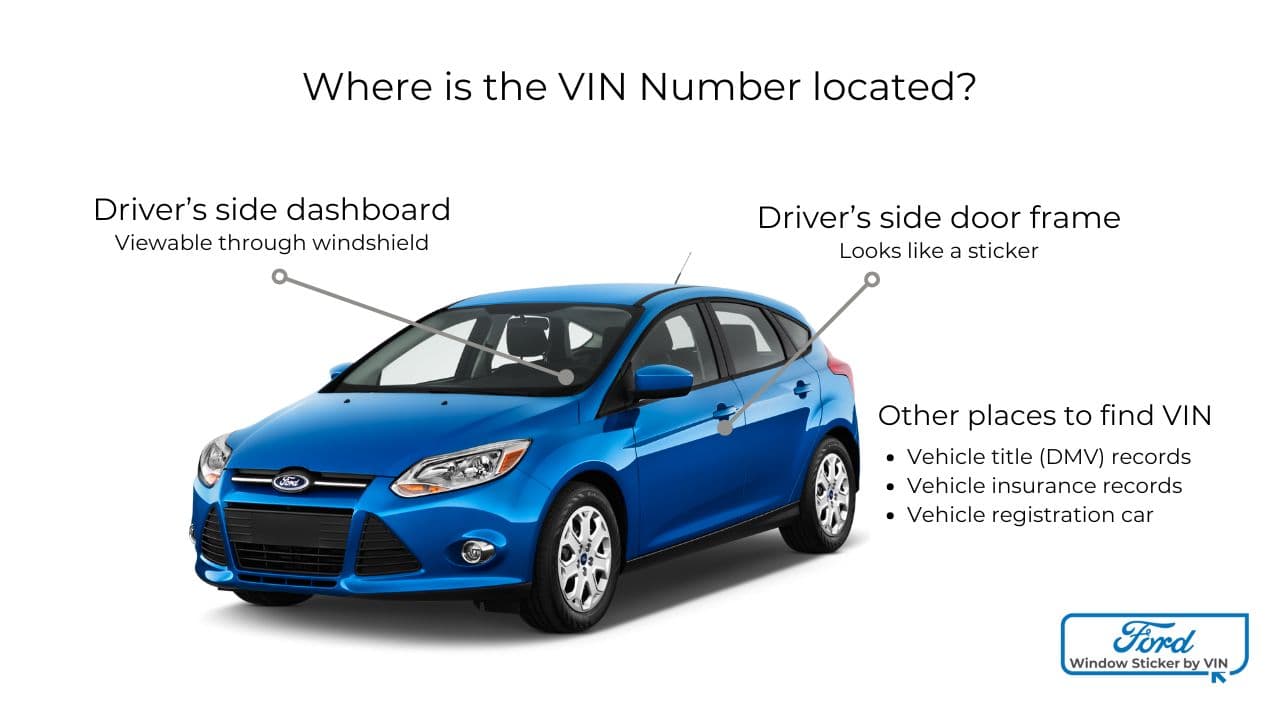
You can usually find the VIN on the driver-side dashboard near the windshield, on the driver-side door jamb, on the title, registration, insurance card, or maintenance documents. Some Ford owners may also find it through their Ford account, Ford app, or SYNC screen.
Yes, but classic Ford vehicles may use shorter VINs or additional identification plates instead of a modern 17-character VIN. For classic models, a build sheet, door tag, data plate, paint code, axle code, or trim code may provide more complete information.
A free decoder may show basic trim or configuration details, but it may not show the complete list of factory-installed options and packages. For original options, packages, MSRP, colors, and standard equipment, a Ford window sticker is usually the better tool.
A basic VIN decoder usually focuses on vehicle identification and specifications. Accident records, title brands, odometer readings, theft records, liens, and auction history are usually found in a vehicle history report, not a basic free decoder.
Yes. A Ford window sticker lookup can use the VIN to find available factory details such as original MSRP, standard equipment, optional equipment, packages, colors, fuel economy, safety ratings, and warranty information.
A VIN may not decode if it is entered incorrectly, has missing characters, belongs to a classic vehicle with a shorter format, or has limited available records. Check the VIN carefully and make sure the letters I, O, and Q are not used in modern VINs.