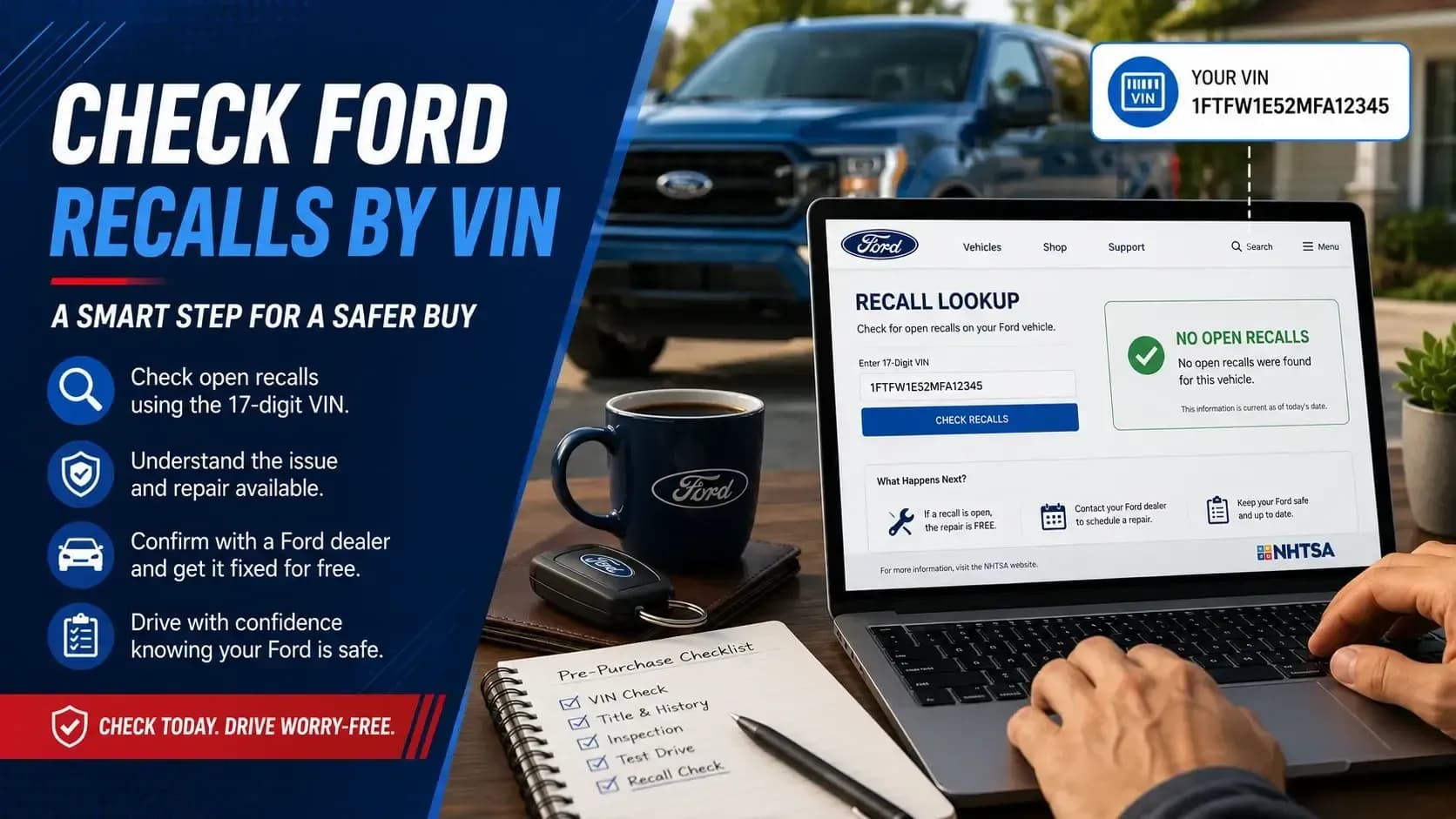
A recall check takes only a few minutes, yet it may uncover a safety issue that a test drive cannot reveal. Before buying a used Ford, copy its 17-digit VIN and check whether that exact vehicle has an unrepaired recall.
Start with the Ford recall lookup, then confirm any open campaign with an authorized Ford dealer. Do this before paying a deposit. Ford recalls are VIN-specific, and affected vehicles may be identified by build dates, assembly plants, or other production factors. Two similar-looking Fords can therefore return different results.
Key Takeaways
- Match the VIN on the vehicle with the title and registration before searching.
- An open recall is not always a deal-breaker, but its risk and repair timing must be clear.
- “No open recalls” does not replace an inspection or broader vehicle-record check.
What Does a Ford Recall Check Actually Tell You?
A vehicle recall lookup answers one focused question: does this specific Ford need an unrepaired recall repair? A VIN search is more precise than searching only by year, make, and model, which returns broader safety information.
The result usually gives you three useful pieces of information.
The Exact Vehicle’s Recall Status
The search shows whether the Ford’s VIN is associated with an unrepaired safety campaign. That matters because a recall may apply to only part of a model-year production run.
A seller may say, “That recall was only for some of them.” They may be right. The VIN is what settles it.
The Affected Part and Safety Risk
The campaign may concern an air bag, brake component, steering part, fuel-system item, camera, seat belt, electrical connection, or software-controlled feature.
Read the safety consequences, not just the part name. A “software update” may sound minor, but software can affect visibility, warning systems, or vehicle movement.
The Manufacturer’s Repair
The recall notice should explain whether the remedy involves an inspection, adjustment, replacement part, or software update. Ford says repairs specifically named in a recall announcement are completed at no cost when the VIN qualifies.
Free is good news. Timing still matters. The repair may be quick, or it may depend on parts availability and dealer scheduling.
How Do You Check Open Ford Recalls Using the VIN?
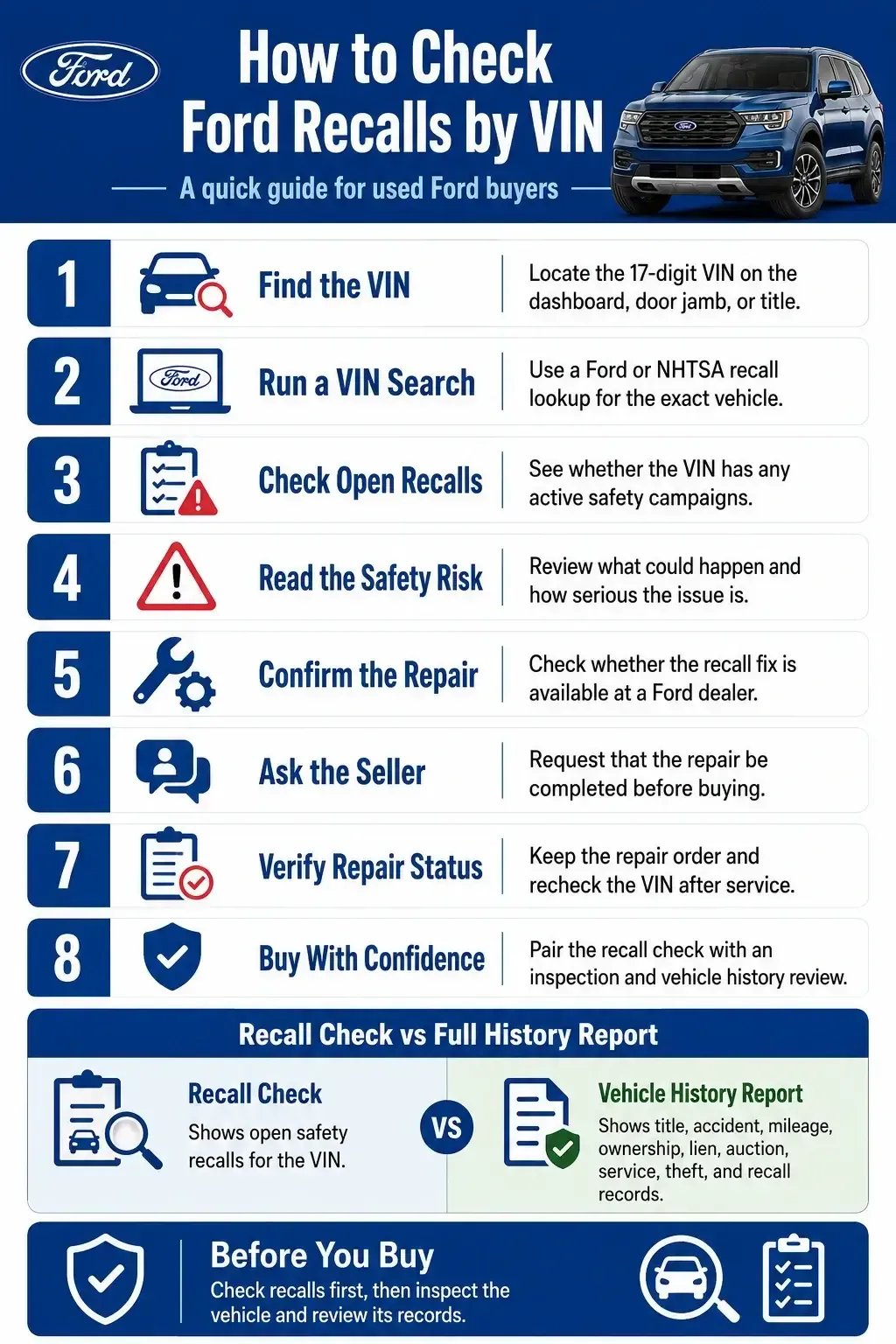
When buyers ask how to check car recalls by VIN, the online search is rarely the hard part. The important work is verifying the number, reading the complete result, and confirming the repair with a dealer.
Use this six-step process before treating the recall question as settled.
Find the VIN on the Ford
Look through the lower driver-side corner of the windshield. You may also find the VIN on the driver-side door-jamb label, title, registration, or insurance card.
NHTSA identifies the lower windshield and registration documents as common locations for the 17-character VIN.
Match It With the Paperwork
Compare all 17 characters with the title, registration, door label, and sales documents. Every character should agree.
One wrong digit can return information for another vehicle. A mismatch may be a harmless typing error, but it can also signal a paperwork problem. Pause until the seller explains it.
Run a VIN-Specific Search
Enter the complete VIN without spaces into a Ford or NHTSA recall search. NHTSA says a VIN or license-plate search can show whether a specific vehicle needs repair as part of a recall.
This answers the common question, “How do I find open safety recalls using my 17-digit VIN?” Use the number attached to the vehicle, not only the one displayed in an online advertisement.
Read the Full Campaign Record
Do not stop at the headline. Note the recall number, affected component, safety consequence, proposed remedy, and any driving or parking instructions.
A routine dealer update and a “do not drive” warning are very different situations. The complete record tells you how much urgency the issue deserves.
Call an Authorized Ford Dealer
Give the service adviser the VIN and recall number. Ask whether the campaign remains open, whether the remedy is available, how long the repair should take, and whether the vehicle is safe to drive.
Ford states that recall repairs must be completed by an authorized Ford dealer.
Save the Result With Your Notes
Take a screenshot or print the result. Record the dealer’s response, repair timing, and appointment details.
Honestly, used-car information becomes muddled fast. After viewing three silver F-150s in one weekend, it is easy to attach the wrong recall result to the wrong truck.
A recall is only one part of the VIN story. Read what a Ford VIN check can reveal before buying to see which specifications and records deserve attention next.
What Should You Do When the VIN Shows an Open Recall?
An open recall may look like a red flag waving over the hood. Sometimes the issue is urgent. Sometimes the repair is straightforward.
Either way, slow down. The goal is not to panic; it is to remove uncertainty before ownership changes.
Understand the Immediate Risk
Read the official safety consequence and any special instructions word for word. If the notice says not to drive the vehicle or to park it outside, treat that as a firm warning.
Do not let a smooth test drive override the recall language. A defect does not need to appear during fifteen minutes around the block to be real.
Confirm That the Remedy Is Available
Ask whether the correct part, inspection procedure, or software update is ready for that VIN. Also ask how soon the dealer can schedule the work.
A no-cost remedy is useful, but a long delay may disrupt commuting, towing plans, family travel, or a quick resale.
Decide Who Will Complete the Repair
The cleanest arrangement is usually for the seller to complete the recall before delivery. A dealership may coordinate the work through its service department.
In a private sale, put the repair plan and payment timing in writing. A promise to “handle it next week” is not the same as a completed repair order.
Verify the Completed Work
Request paperwork showing the VIN, campaign number, service date, dealer name, and work performed. Then check open recalls by VIN again after the database has had time to update.
NHTSA’s lookup focuses on unrepaired recalls, so completed recall work may no longer appear in the search results. Keep the service paperwork as evidence.
Why Is “No Open Recalls” Not a Full Green Light?
Seeing zero unrepaired recalls is reassuring, but it is not a complete health certificate for the Ford.
NHTSA says its VIN search may not show repaired campaigns, some recently announced recalls whose VIN lists are still being developed, certain recalls more than 15 years old, non-safety service campaigns, or recalls involving international vehicles.
A clean result should therefore sit beside four other checks:
- Mechanical condition: Have an independent mechanic look for rust, leaks, worn tires, cooling trouble, and poor collision repairs.
- Title and ownership records: Review title brands, odometer events, accidents, auctions, and previous vehicle use.
- Factory configuration: Confirm the correct trim, engine, drivetrain, packages, and towing equipment.
- Future recall status: Check again after purchase because new campaigns may be announced and affected VIN lists can be updated.
Ford also distinguishes safety recalls from Customer Satisfaction Programs, which may provide an upgrade or warranty extension and can carry time or mileage limits. Ask the dealer whether either type of program applies.
The used Ford buying checklist can help you combine recall research with inspection, paperwork, history, and condition checks.
Should an Open Recall Change Your Offer?
An open recall should change the buying process, though it does not always justify a large discount. The recall repair itself is generally free when the VIN qualifies.
The real costs may be time, transport, lost use, and uncertainty. If parts are unavailable or the vehicle carries a driving restriction, that inconvenience matters. If the seller refuses to arrange a straightforward repair, that behavior also tells you something.
For a dealer vehicle, request that the recall be repaired before delivery. For a private sale, decide whether the price and timing still make sense once the campaign is understood.
The recall should inform the deal, not become a dramatic bargaining trick.
Check the Recall Before the Deal Feels Final
Once you have test-driven the Ford, pictured it in your driveway, and started discussing payment, it becomes harder to slow down. That is exactly why the recall check belongs near the beginning.
Use the VIN displayed on the vehicle. Read the complete campaign record. Confirm any open repair with an authorized Ford dealer, and keep the documentation.
Before money changes hands, check your Ford for open recalls. A few careful minutes now can prevent an inconvenient and potentially unsafe surprise later.
Frequently Asked Questions
How do I check if my Ford has an open recall by VIN?
Enter the complete 17-digit VIN into a Ford or NHTSA recall lookup. Review the result for unrepaired campaigns, then confirm the remedy and repair timing with an authorized Ford dealer.
Can I buy a used Ford with an open recall?
Yes, but first understand the safety risk, confirm that the repair is available, and decide who will complete it. Having the seller repair the vehicle before delivery is often the cleanest arrangement.
Are Ford recall repairs free?
Ford says repairs specifically designated in a recall announcement are completed at no cost when the vehicle’s VIN is included and the work is performed by an authorized Ford dealer.
What should I do if my VIN recall check shows an open safety recall?
Read the official warning, contact a Ford dealer, confirm repair availability, and ask the seller to complete the work before the sale when practical. Keep all repair documents.
Does zero unrepaired recalls mean the Ford has no problems?
No. It only means the search did not find an unrepaired recall associated with that VIN at that time. It does not replace an inspection, title review, or vehicle-history check.
Can a Ford recall appear after I buy the vehicle?
Yes. New campaigns may be announced later, and affected VIN lists can be updated. Check the VIN periodically and keep your registration and contact details current.