
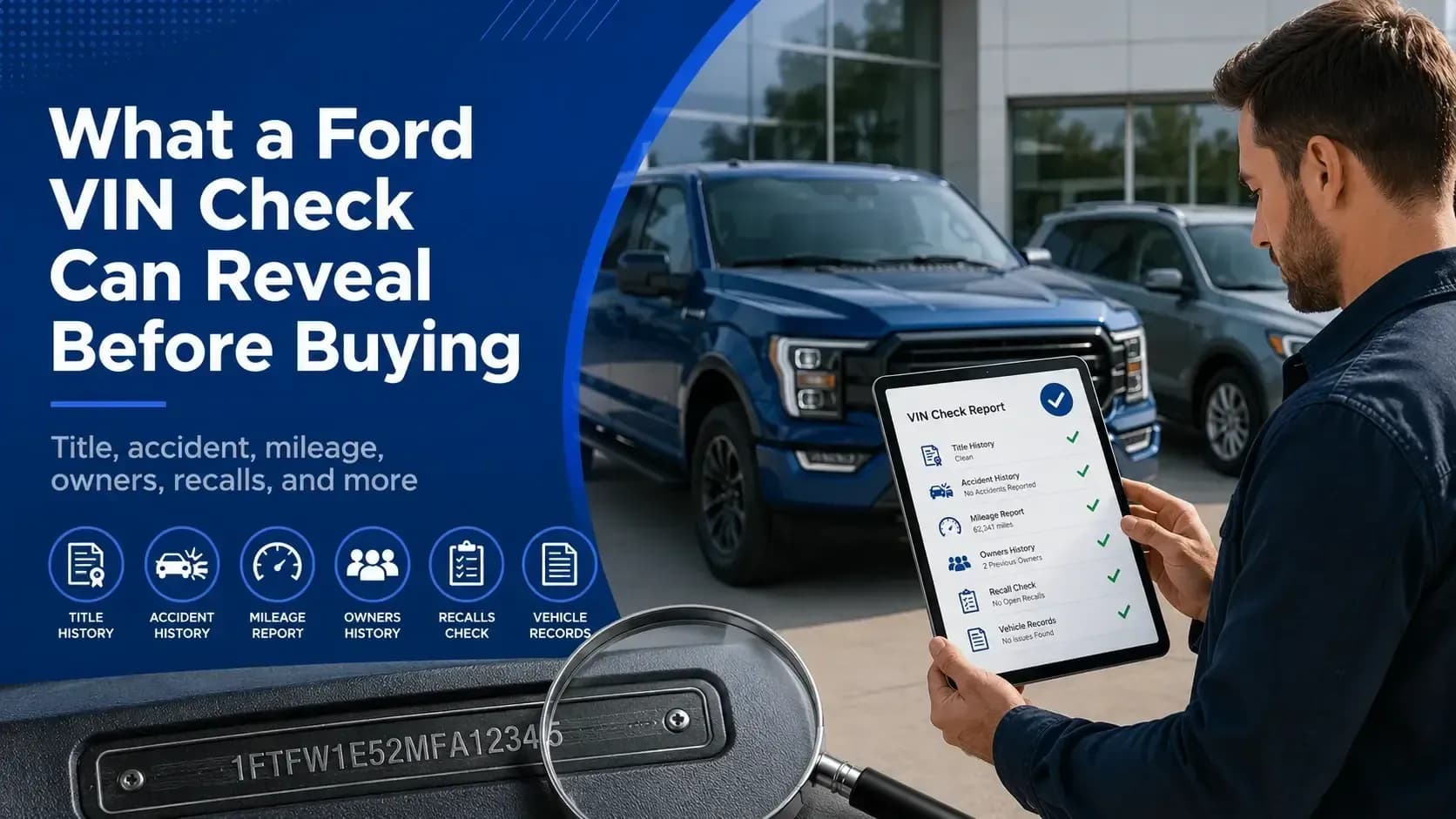
A Ford VIN check can reveal important details before you buy, including title records, accident history, mileage records, ownership history, recall status, auction activity, lien records, and basic vehicle specs when available. It will not tell you everything, but it can give you the first real look behind the seller’s story.
That matters. A used Ford can look clean in photos, sound good in a listing, and still carry records that change the deal. If you want to check available title, accident, odometer, ownership, lien, auction, service, and recall records, start with a Ford vehicle history report before you meet the seller or send a deposit.
Key Takeaways
- A VIN check for used cars before buying can reveal records tied to the vehicle’s identity, history, and risk.
- A free VIN decoder usually shows basic specs, while a paid history report can show title, accident, mileage, ownership, and other records.
- A VIN check is powerful, but it should still be paired with a test drive, inspection, and seller questions.
First, What Does a VIN Check Reveal?
A VIN check reveals information connected to a vehicle’s 17-character VIN. For a used Ford, that can include factory identity, title events, accident records, mileage readings, recall records, sales activity, service records, and other history details when available.
Here’s the simple version: the VIN is the car’s fingerprint. It follows the vehicle from factory records to DMV events, insurance records, auctions, service visits, and resale listings. Not every record appears every time, but the VIN gives you a trail to follow.
When people ask what a VIN check reveals, they usually want to know one thing: “Can this help me avoid a bad used car?” Yes, it can help. But it works best when you know what each section means.
Vehicle Identity: Is This Ford Really What the Seller Says?
Before worrying about accidents or price, confirm the Ford’s identity. This is the basic first step, but buyers skip it more often than they should.
A VIN check may help confirm these details:
Year, Make, and Model
The VIN can help identify whether the vehicle is a Ford F-150, Mustang, Explorer, Escape, Bronco, Ranger, Fusion, or another model. This should match the listing and paperwork.
Trim and Body Style
Trim matters because value can change a lot between versions. A Ford F-150 XL and a Lariat are not the same buying decision, even if the photos look similar at first glance.
Engine and Drivetrain
Engine, transmission, drivetrain, and body details can affect towing, fuel cost, repair cost, and resale value.
Country and Vehicle Type
Some VIN data may show manufacturing location, body class, fuel type, or vehicle classification.
This is the “don’t get fooled by the badge” stage. If the basic identity does not match, slow down.
Title Records: The Part That Can Change Everything
Title history is one of the biggest reasons to run a VIN check. A Ford can look sharp on the outside and still have a title brand that affects insurance, financing, resale, and long-term trust.
Before buying, check for title-related records like these:
Clean Title
A clean title usually means no major title brand is currently attached. That is good, but it does not guarantee the vehicle has never been damaged.
Salvage or Rebuilt Title
A salvage or rebuilt title means the vehicle had a serious event in its past. Some rebuilt vehicles are repaired well. Some are not. Either way, the price should reflect the risk.
Flood, Junk, or Lemon Branding
These brands deserve extra caution. Flood vehicles, in particular, can hide electrical problems that appear later like an unwanted surprise party.
Manufacturer Buyback
A buyback may mean the vehicle had repeated issues. It does not always make the Ford impossible to buy, but you need context.
Title history is not glamorous. But it can be the difference between a smart buy and a headache with wheels.
Accident, Damage, and Auction Records
A VIN check may show accident reports, damage records, insurance loss events, auction history, or sale listings. This is where the vehicle’s past starts to feel less abstract.
Here’s what a VIN check shows when damage records are available:
Accident Records
Accident records may show that a crash was reported, sometimes with date, location, or severity indicators. Details vary by source.
Damage Type
Some records may mention front-end damage, side damage, rear damage, hail damage, water damage, or structural concerns. Do not treat every damage record the same.
Auction Activity
Auction records can reveal seller type, sale date, title status, reported damage, or sale price when available. For flippers, this can be useful.
Insurance Loss Events
Insurance-related records may show total loss, theft recovery, or other events that changed the vehicle’s status.
Still, here’s the catch: a VIN check may not show every repair. A small cash repair might never hit a major database. That is why records and inspection need to work together.
Mileage Records: Does the Odometer Story Make Sense?
Mileage affects price, trust, and future resale. It also tells you how much life the vehicle may have left before major maintenance starts knocking.
A VIN check can help compare mileage across different records:
Odometer Readings
Mileage may appear from title events, inspections, service visits, auctions, emissions checks, or sale listings.
Mileage Consistency
The readings should move forward in a logical order. A sudden drop, repeated odd number, or strange gap should make you ask questions.
Last Known Mileage
Some reports may show the most recent mileage record available. Compare it with the current odometer.
Mileage Gaps
No records for a long period does not always mean trouble, but it does leave more room for uncertainty.
This is one reason a VIN check for used cars before buying is useful before you test drive. If the mileage story already feels off, you may save yourself a trip.
Ownership, Lien, Service, and Recall Records
A used Ford has more than accident and title history. Ownership patterns, financial records, service notes, and recall data can also shape the buying decision.
Review these areas before you get too comfortable with the listing:
Ownership History
A vehicle may show one owner, multiple owners, fleet use, lease use, or commercial use when available. None of these are automatically bad, but they do affect context.
Lien or Loan Records
A lien may mean another party has a financial claim on the vehicle. Make sure the seller can prove the lien is released before you pay.
Service and Maintenance Records
Service records may show oil changes, brake work, tire replacement, recall service, warranty work, or major repairs. A boring service record can be a beautiful thing.
Open Recalls
A VIN check may show open recalls. For Ford trucks, SUVs, family cars, and daily drivers, this deserves attention before buying.
If you are still building your full inspection plan, this used Ford checklist can help next: what to check before buying a used Ford.
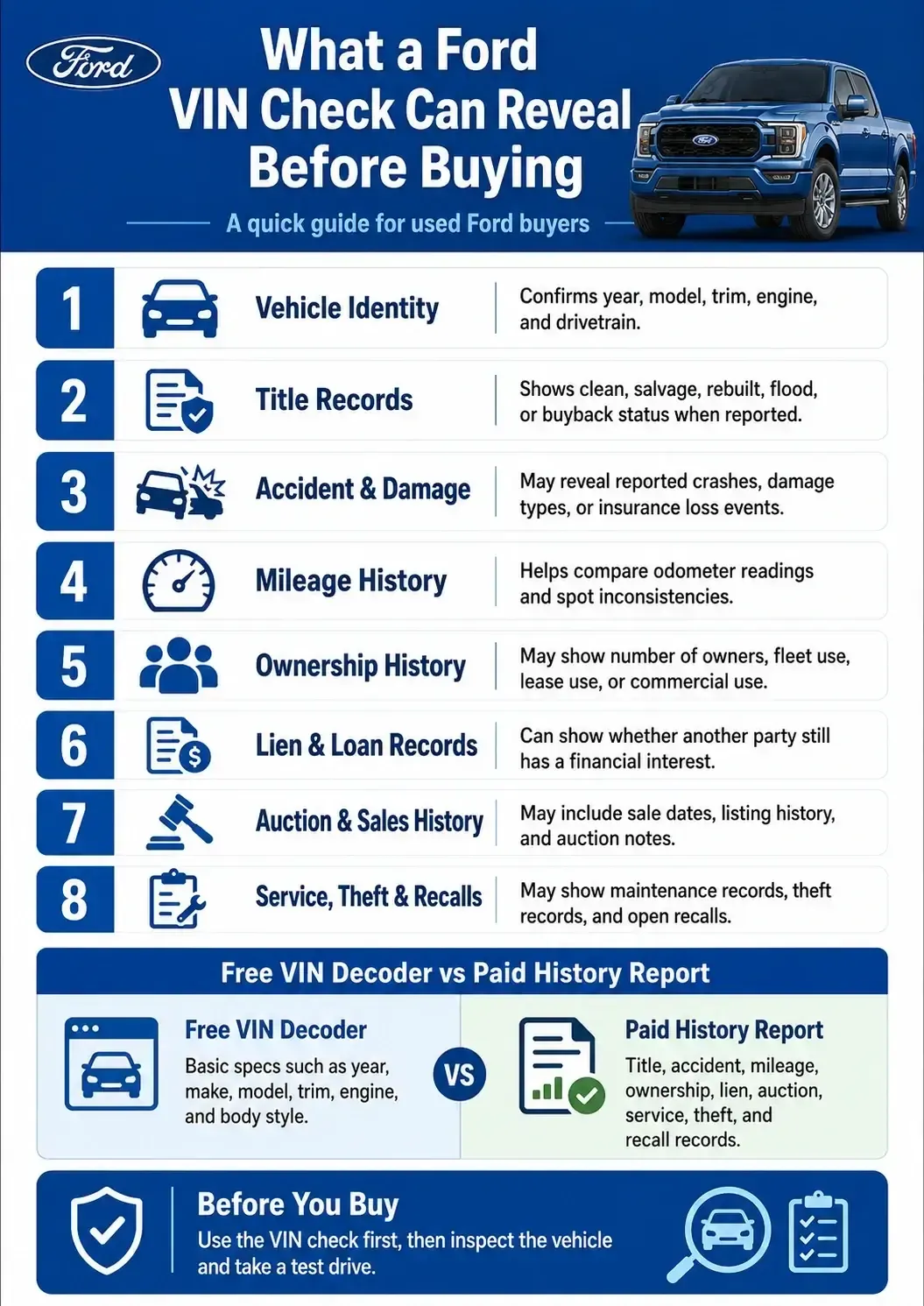
Free VIN Decoder vs Paid Vehicle History Report
This part confuses a lot of buyers. A free VIN decoder and a paid vehicle history report can both use a VIN, but they do different jobs.
Before you choose one, understand the difference:
Free VIN Decoder
A free VIN decoder usually shows basic vehicle identity. It may include year, make, model, trim, engine, body style, drivetrain, fuel type, and other specs when available.
Paid Vehicle History Report
A paid history report can go beyond specs and show available title records, accident history, mileage events, ownership records, auction activity, lien records, theft records, service history, and recalls.
That is the clearest answer to what does a free VIN decoder show vs paid history report. One explains identity. The other explains history.
For a closer comparison between factory details and post-sale records, read Ford vehicle history report vs window sticker.
What a VIN Check Cannot Promise?
A VIN check is useful, but it is not magic. Honestly, this part matters because overtrusting a report can be just as risky as not checking one at all.
Here’s what a VIN check may not fully prove:
❌ Hidden Repairs
If repairs were paid in cash or never reported, they may not appear in the records.
❌ Current Mechanical Condition
A VIN check does not tell you how the engine sounds today, how the transmission shifts, or whether the brakes feel right.
❌ Every Accident
Not all accidents are reported to insurance, police, auctions, or data providers.
❌ Future Reliability
A clean report does not guarantee the Ford will be trouble-free. Maintenance, age, mileage, and how it was driven still matter.
So, use the VIN check as a filter. Then inspect the vehicle, ask questions, and get a pre-purchase inspection if the purchase matters.
How to Use VIN Check Results Before Buying?
Once you have the report, do not just scan for the word “clean.” Read it like a buyer, not like someone trying to justify a purchase.
Use this order:
Confirm the Identity First
Make sure the VIN, model, trim, engine, drivetrain, and body style match the listing and documents.
Check Title and Mileage Next
These two areas can affect price, trust, insurance, and resale value.
Review Accident and Damage Records
Look at dates, damage type, title changes, auction notes, and repair clues.
Compare Records With the Vehicle
If records show front-end damage, inspect the hood, bumper, grille, headlights, radiator area, and panel gaps.
Ask the Seller Direct Questions
Use the records to ask better questions, not to start an argument. Calm questions usually get better answers.
Decide What the Risk Is Worth
Some records lower the price. Some require inspection. Some are deal-breakers. The point is to know before you buy.
Final Thoughts: A VIN Check Helps You Buy With Your Eyes Open
A Ford VIN check does not replace common sense. It does not replace a test drive. It does not replace a mechanic.
But it can reveal the records that a listing may leave out.
If you are asking what information does a VIN check show before buying a used car, the answer is: it can show the identity, title story, accident history, mileage records, ownership trail, auction notes, lien records, service history, and recall status when available.
That is not everything, but it is a lot.
Before you buy, check the VIN, inspect the Ford, compare the seller’s claims, and do not rush the deal. If the records look good and the vehicle checks out in person, you can move forward with a clearer head.
Need to review the history side before making a decision? Use a Ford vehicle history report to check available title, accident, mileage, lien, auction, ownership, service, and recall records.
Frequently Asked Questions
What does a VIN check reveal?
A VIN check can reveal vehicle identity, title records, accident history, damage reports, mileage records, ownership history, auction records, lien records, theft records, service history, and recall status when available.
What information does a VIN check show before buying a used car?
Before buying a used car, a VIN check may show whether the vehicle has title brands, accident records, mileage inconsistencies, open recalls, ownership changes, lien records, auction events, or service history.
What is included in a vehicle history report?
A vehicle history report can provide information such as title history, accidents, miles on odometer, ownership information, service information, auctions, thefts, liens and recalls.
Can a VIN check tell if a car has been flooded?
A VIN check can sometimes show flood branding, damage due to water, salvage history, insurance loss or auctions associated with flood damage. But it will not be able to detect every incident of flooding. Therefore, look for moldy smell, corrosion, electrical problems, and water marks.
How to check if a used car mileage is real using VIN?
Use the VIN to compare mileage records from title events, service visits, inspections, emissions records, auction listings, and sale listings. The mileage should increase in a logical timeline. If it drops or looks inconsistent, ask for proof.
How many past owners are reflected in a vehicle history report?
The number of past owners who will reflect in the vehicle history check depends on the records that exist. Sometimes there might be records of one, many, fleet, lease, and commercial owners.
Can a VIN check tell about any hidden frame damages on a car?
While there might be indications of structural frame damages, major accidents, salvaged status, or auction damage from a VIN check, sometimes hidden frame damage might go unnoticed if it had not been reported.
What does a free VIN decoder show vs paid history report?
A free VIN decoder usually shows basic specs like year, make, model, trim, engine, drivetrain, and body style. A paid history report can show available title, accident, mileage, ownership, lien, auction, service, theft, and recall records.